We have been busy preparing for Easter this week. The Kindy children have been working hard to create their Easter Bonnets and can't wait to show them to you next week. A friendly reminder that group 1's parade is on Tuesday and group 2's is on Thursday at 2pm. You are welcome to bring a picnic to share with your family after the parade and this will be a lovely opportunity to get to know the other Kindy families.
Room 4 have also been busy making chicken and rabbit Easter baskets and are hoping that we may have a special visitor (the Easter Bunny) come to our parade so that they can use them.
Over the past few weeks we have been learning many number rhymes to aid us in learning the order of numbers and also in counting small quantities. One of these rhymes is 5 Little Chicks. The children made a 5 Little Chicks craft so that they can act out the rhyme and count the number of chicks left. These will be coming home next week and I'm sure the Kindy children would love to sing the rhyme for you and show you how they work.
Here are the Kindy children proudly displaying their baskets and 5 Little Chicks craft.
Thursday, 17 March 2016
Friday, 11 March 2016
Rosie's Walk Miniworld
Room 4 has been learning the words and actions to Rosie's Walk over the past few weeks and are getting quite good at retelling the story. To aid the children in their comprehension of the text and to demonstrate their understanding of positional language our Kindies acted out the story using a mini replica of the setting and characters. We saw some very spirited retellings!
Buddy Up!
We are incredibly lucky to go to school at YBPS where the big waves and little waves can learn, play and create together. Over the course of the year, we will buddy up with Ms Ricciardone & Room 14. Our little waves met the big waves from year 5/6 for the first time last week and had a brilliant time. Buddy class allows us to engage with students in our school who we would not normally have the opportunity to work closely with and create lasting friendships. We are looking forward to all the wonderful activities we will complete together and the skills we will learn from each other.
Friday, 4 March 2016
Shape Hunting
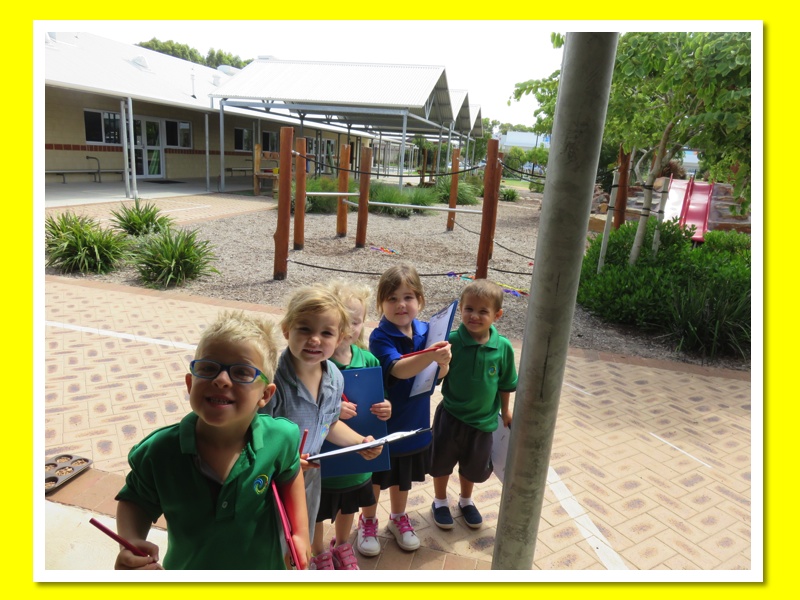
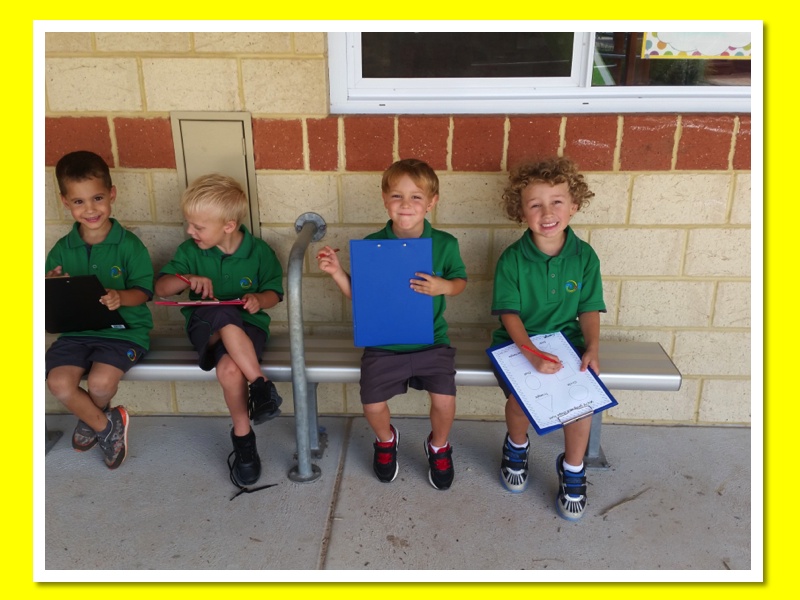
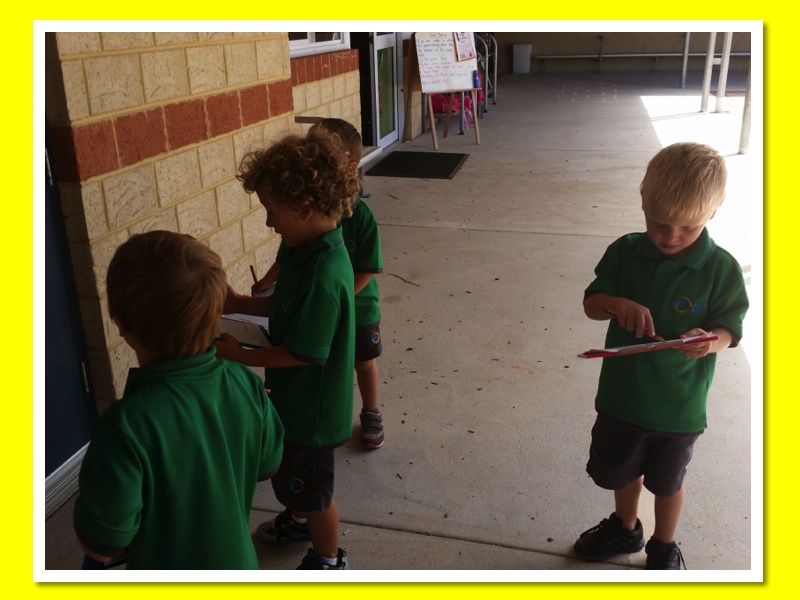
The Kindergarten children have been learning about shapes this week. We have been learning to identify 2D shapes and describe their attributes. To help us on our learning journey we went on a shape hunt around the school. We recorded our findings and discovered more circles than any other shape and that stars were hard to find. I wonder how many shapes you could find on your way to school?
Thursday, 25 February 2016
Talk for Writing- Rosie's Walk
This term our Talk for Writing text is Rosie's Walk by Pat Hutchins. One of our class focuses will be understanding and using positional language.
We had a special delivery this week from Rosie the Hen. She sent us an envelope that directed us to follow her clues to find a treasure! When we returned to the classroom there was a treasure chest filled with chocolate treats and pictures from the story. It was a very exciting morning!

Thursday, 18 February 2016
Letters and Sounds- A listening walk
We began our Letters and Sounds Program this week by creating listening ears and going on a listening walk around the school. We discovered the sounds we can hear in our environment and discussed the importance of listening. We heard cars, the wind rustling the leaves, people talking, leaves crunching underfoot, stomping, water trickling down the water fountains and birds singing in the trees. We are learning to tune into the sounds in our environment so that we can eventually hear the individual sounds in words. This will help us learn to read and write. Why not try going on a listening walk (or drive) on the way to school next week?
The Letters and Sounds Program is a whole school program that has 6 phases. In Kindergarten we will primarily be focussing on Phase 1 which gets the children to tune into sounds. Phase 1 comprises of 7 aspects.
Aspect 1 - General sound discrimination - environmental
The aim of this aspect is to raise children's awareness of the sounds around them and to develop their listening skills. Activities suggested in the guidance include going on a listening walk, drumming on different items outside and comparing the sounds, playing a sounds lotto game and making shakers.
Aspect 2 - General sound discrimination - instrumental sounds
This aspect aims to develop children's awareness of sounds made by various instruments and noise makers. Activities include comparing and matching sound makers, playing instruments alongside a story and making loud and quiet sounds.
Aspect 3 - General sound discrimination - body percussion
The aim of this aspect is to develop children's awareness of sounds and rhythms. Activities include singing songs and action rhymes, listening to music and developing a sounds vocabulary.
Aspect 4 - Rhythm and rhyme
This aspect aims to develop children's appreciation and experiences of rhythm and rhyme in speech. Activities include rhyming stories, rhyming bingo, clapping out the syllables in words and odd one out.
Aspect 5 - Alliteration
The focus is on initial sounds of words, with activities including I-Spy type games and matching objects which begin with the same sound.
Aspect 6 - Voice sounds
The aim is to distinguish between different vocal sounds and to begin oral blending and segmenting. Activities include Metal Mike, where children feed pictures of objects into a toy robot's mouth and the teacher sounds out the name of the object in a robot voice - /c/-/u/-/p/ cup, with the children joining in.
Aspect 7 - Oral blending and segmenting
In this aspect, the main aim is to develop oral blending and segmenting skills.
To practise oral blending, the teacher could say some sounds, such as /c/-/u/-/p/ and see whether the children can pick out a cup from a group of objects. For segmenting practise, the teacher could hold up an object such as a sock and ask the children which sounds they can hear in the word sock.
The activities introduced in Phase 1 are intended to continue throughout the following phases, as lots of practice is needed before children will become confident in their phonic knowledge and skills.
Subscribe to:
Posts (Atom)